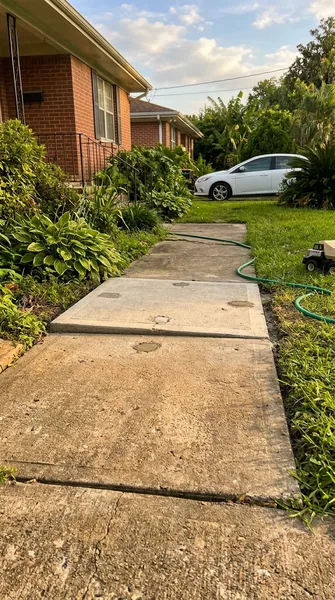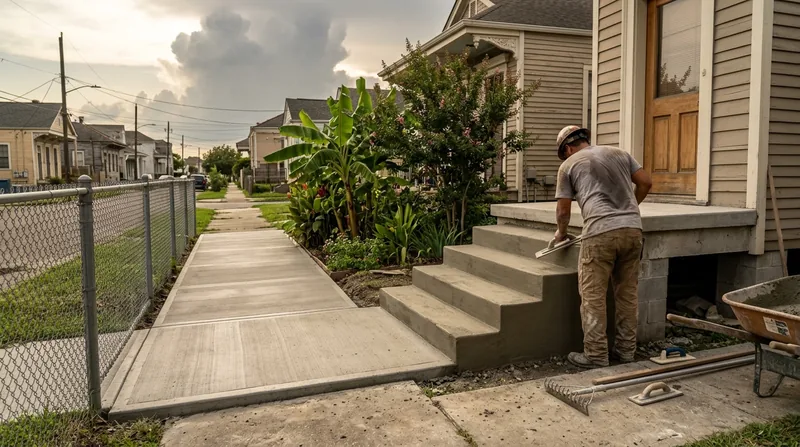




Sidewalks, walkways, and steps in New Orleans take a beating from the ground itself. The soft, wet backswamp clays and organic marsh soils that sit beneath this city shift and settle unevenly, lifting tree roots through pavement and leaving concrete cracked, heaved, and unsafe. Add 60 inches of rain a year, daily summer thunderstorms, and the relentless humidity that accelerates concrete deterioration, and you get the reason why New Orleans sidewalks fail faster than in almost any other American city. Whether your walkway is buckled by a live oak root in the Garden District, sinking into the subsiding slab in Mid-City, or crumbling from age and weather in Bywater, we build new sidewalks, walkways, and steps that stand up to this climate and terrain. We handle everything from small front-yard repairs to full neighborhood replacements, all to local permit standards and ADA compliance. Call us at (504) 565-2441 for a free estimate, or visit our homepage to learn more about our full range of concrete services.
Why Sidewalks, Walkways, and Steps Fail So Fast in New Orleans
The problem is not age alone. New Orleans sits at or below sea level on a shallow water table, and the ground beneath most residential lots is a mix of soft clay, organic muck, and compressible fill. Live oak roots, some as thick as a human torso, push upward through concrete year after year. Heavy summer rains saturate the soil and cause settlement; drainage issues around raised houses create localized sinking. Concrete that was poured without proper reinforcement, thickening, or subsurface prep simply cannot hold. Unrepaired cracks trap water, freeze-thaw is rare but moisture penetration and salt air (especially near the river and in Chalmette) accelerate spalling and deterioration. The result is a city full of tripping hazards, liability risks, and accessible barriers that make it unsafe and difficult to move around your own property.
- We remove buckled and heaved sections caused by live oak and cypress root pressure beneath the surface.
- We pour new walks and steps with thicker reinforced slabs and proper subsurface preparation to resist settlement.
- We install slip-resistant finishes and code-compliant slopes to meet ADA and local accessibility standards.
- We handle all local permitting, including right-of-way compliance and curb-cut requirements for sidewalks fronting the street.
- We seal finished concrete to slow moisture infiltration and mildew growth in this humid climate.
Safe, durable access around your home is not a luxury in New Orleans; it is essential infrastructure that protects your family and your property value.
Key info: New Orleans requires permits for sidewalk work in the right-of-way and often mandates ADA-compliant slopes (1:12 maximum) and landing widths. Homeowners should verify setback rules and width limits with the local Department of Public Works before work begins. We handle all paperwork and code review.
For more on how concrete fails in wet, soft soils, see the Concrete Repair and Resurfacing page, or learn about Concrete Leveling and Slab Lifting if your walkway is sinking.
How We Build Sidewalks, Walkways, and Steps That Last in New Orleans
Our process starts with understanding the soil. We excavate to the proper depth, remove any unstable fill or organic material, and compact the subgrade. We then install a crushed-stone base and proper drainage to keep water from pooling beneath the slab. We pour reinforced concrete, typically 4 to 6 inches thick depending on expected foot traffic and soil conditions, with wire mesh or rebar to distribute stress. We finish the surface with a broom texture or non-slip coating to meet safety codes, slope the walk away from buildings to shed water, and cure the concrete properly in New Orleans heat and humidity. Every step, every corner, every edge is built to code and to survive the climate.
- We assess soil conditions, subsurface water, and tree root presence before any excavation begins.
- We remove old concrete and dispose of debris responsibly, leaving the site clean and safe.
- We build a solid base with compacted stone and proper drainage so the new walk will not settle or crack prematurely.
- We pour and finish concrete to ADA slope and width standards, with slip-resistant texture for safety.
- We apply a concrete sealer to protect against moisture, mildew, and UV damage in this humid, rainy climate.
- We coordinate with the city or HOA for permits and inspections, and we leave your property looking finished and professional.
The result is a sidewalk or walkway that will serve your home safely for 15 to 25 years, even in the demanding New Orleans environment.
Local example: A homeowner in the Garden District near St. Charles Avenue had a front walk buckled by a live oak root. We removed 120 square feet of old concrete, excavated 18 inches deep to avoid remaining roots, poured a 5-inch reinforced slab with proper slope, and finished with a broom texture. The new walk is ADA-compliant, cost $840 (approximately $7 per square foot), and has remained level and crack-free for three years.
Sidewalk and Walkway Methods: Which Approach Works for Your Home
| Approach | Description | Best for |
|---|---|---|
| Full removal and replacement | We remove old concrete, excavate, prepare the base, pour new reinforced slab, finish and seal. | Buckled, cracked, or sinking walks; roots or drainage issues; ADA compliance upgrades. |
| Concrete leveling | We inject foam or grout beneath a sunken slab to lift it back to grade without removal. | Minor settlement; walks that are still structurally sound but have dropped 1 to 3 inches. |
| Partial repair and resurfacing | We patch or resurface damaged sections, grind high spots, and seal the entire walk. | Spalling, small cracks, or surface wear on otherwise stable concrete. |
| New steps and landings | We build code-compliant exterior stairs with proper rise, run, handrail provisions, and non-slip finishes. | Raised or pile-supported homes in New Orleans that need safe entry and accessible landings. |
Sidewalks, Walkways, and Steps Cost in New Orleans: What to Expect
Pricing for new sidewalks and walkways in New Orleans typically starts at $6 per square foot for a basic removal and pour. A 100-square-foot front walk (roughly 4 feet wide by 25 feet long) would run approximately $600 to $800 before permits and site-specific challenges. That baseline price assumes level, accessible soil with no tree roots, minimal excavation, and a standard broom finish. The actual cost climbs if you have deep root damage, poor soil that needs special preparation, a long or complex walkway, steps with landings, or decorative finishes like stamped or colored concrete. Getting two or three estimates from insured contractors is the best way to understand what your specific job will cost. Visit our pricing page for a more detailed breakdown of factors that move the needle on cost.
Tree root removal, subsurface drainage work, and structural reinforcement for poor soil all add to the bill. Permits, inspections, and right-of-way compliance in New Orleans also require time and expertise that should be reflected in your estimate. Sealing, which we recommend for all New Orleans concrete to fight humidity and mildew, is typically $1 to $2 per square foot and extends the life of your walkway by years. Do not choose a contractor solely on price; choose one who understands New Orleans soil, can explain why the job costs what it costs, and will stand behind the work.
Sidewalks, Walkways, and Steps Near Me: What New Orleans Homeowners Should Know When Hiring a Contractor
When you call a concrete contractor to bid on your walkway or steps, ask for proof of current general liability insurance and workers' compensation coverage. These protect you if someone is injured on your property or if damage occurs during the work. A reputable contractor will provide a certificate of insurance without hesitation. Beyond insurance, request references from recent jobs in your neighborhood (Metairie, Lakeview, Bywater, and the Marigny area all have active concrete work), and call at least two to confirm timely completion and quality finish. Ask whether the contractor will handle all permits and inspections, or if you need to apply to the city yourself. If your home is in an HOA community or a historic district, confirm that the contractor understands local rules and restrictions. Get everything in writing: scope of work, materials, timeline, and total cost. A free estimate should take 20 to 30 minutes and include a site walk and soil assessment.
- Verify current general liability insurance and workers' compensation coverage by asking for a certificate of insurance.
- Request and call references from jobs completed in the past 12 months in your area or similar soil conditions.
- Confirm that the contractor will obtain all required permits and coordinate with the city Department of Public Works for right-of-way work.
- Understand your HOA rules or historic district guidelines if they apply, and ensure the contractor will comply with them.
- Get a written estimate that includes materials, labor, timeline, and any assumptions about soil or site conditions.
- Ask about warranty or guarantees on the finished work, and get that commitment in writing as well.
Choosing the right contractor now saves you money, headaches, and safety issues down the road. Ready to move forward? Contact us for a free estimate or call (504) 565-2441 to discuss your walkway or steps.
Sidewalks, Walkways & Steps in New Orleans: Pricing Guide
| Service | Price | Details |
|---|---|---|
| Basic sidewalk or walkway, removal and replacement | Starting at $6/sq ft | 4-inch reinforced slab, broom finish, proper slope, and seal. Includes excavation, base prep, and standard compacted stone foundation |
| Walkway with root damage or poor soil conditions | Starting at $8/sq ft | Deeper excavation, root removal, improved subgrade preparation, thicker 5-inch slab with rebar, and drainage mitigation for New Orleans soil |
| Steps, landings, and complex access features | Starting at $10/sq ft | ADA-compliant rise and run, handrail provisions, multiple landings, non-slip finishes, and structural reinforcement for safety and code compliance |
| Concrete leveling and slab lifting (alternative to replacement) | Starting at $5/sq ft | Foam or grout injection to raise sunken walks back to grade without full removal. Faster and often less expensive than replacement for minor settlement |
| Sealing and protective coating | $1-$2/sq ft | Applied after new pour or to existing concrete to resist moisture, mildew, and UV damage in New Orleans heat and humidity |
| Free estimate and site assessment | Free | Includes soil evaluation, root inspection, permit and code review, and detailed written quote with no obligation to book |
Indicative pricing, the exact cost depends on square footage, finish, and site access. Free personalized estimate within 24h at (504) 565-2441.