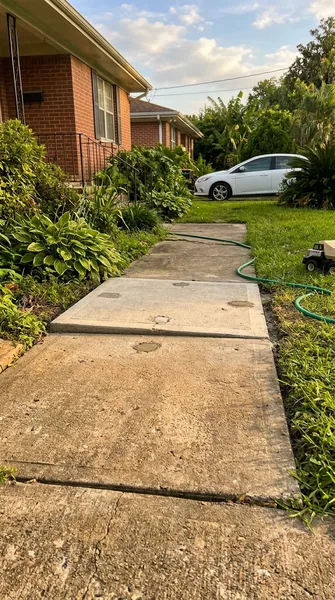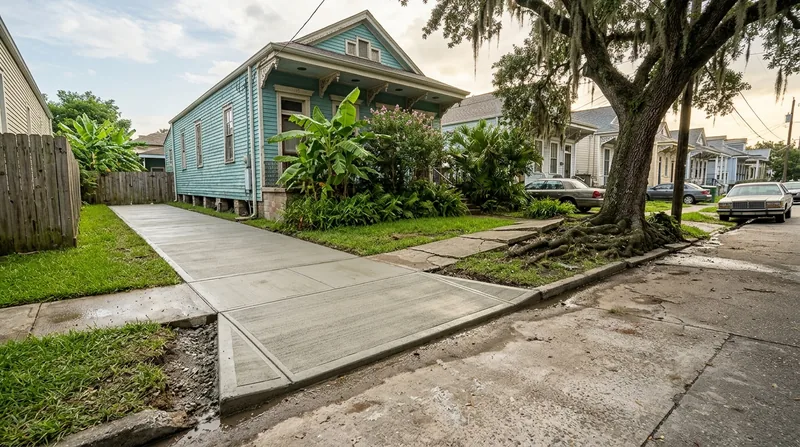




Concrete Slabs & Foundations in New Orleans require a different approach than anywhere else in America. Our city sits on soft backswamp clay and organic marsh soils over a shallow water table, with much of New Orleans at or below sea level. Houses rest on piers or pilings that settle unevenly over decades, and the ground beneath shifts with every heavy rain and summer thunderstorm. A properly engineered slab and footing system stops that movement before it cracks your garage, shed, or room addition. We pour thick, reinforced concrete with compacted base preparation and drainage that handles 60 inches of rain annually, near-daily summer storms, and the relentless humidity that weakens poor installations. Whether you're building new in the Garden District, Mid-City, Metairie, or any part of the Greater New Orleans area, a solid foundation is the difference between a structure that lasts 50 years and one that settles and cracks within five.
Why Concrete Slabs & Foundations Matter in New Orleans: The Subsidence Problem
New Orleans concrete work lives in the shadow of subsidence. Our city's soft soils compact over time, and houses sink an inch or more per decade. Add uneven settlement from pile-supported structures, live oak root systems lifting sidewalks, and seasonal water table fluctuations, and you see why a weak foundation invites disaster. A properly designed slab and footing system distributes weight evenly, resists settling, and keeps your garage floor, shed base, or room addition level and crack-free for decades.
- We engineer slab thickness and steel reinforcement to handle New Orleans soil conditions and prevent differential settlement.
- We compact the base layer to remove voids and ensure uniform support across the entire pour.
- We install proper drainage around the slab perimeter so standing water does not weaken the subgrade in our wet climate.
- We account for future movement by using control joints and thickened edges that anchor to pile-supported house structures.
- We follow local permitting requirements for setbacks, lot coverage, and right-of-way compliance in residential and commercial zones.
A well-built slab stops settling before it starts, keeping your structure sound and your insurance company satisfied.
Key info: In Lakeview and suburban Metairie, 1950s-60s brick slab ranches sit directly on the ground. Many were rebuilt or elevated after Hurricane Katrina. New slabs must account for potential future flooding, subsidence, and the fact that the house structure may shift independently. We design every pour with that reality in mind.
For more on how we handle settlement-prone soil, see our Concrete Leveling & Slab Lifting service, which corrects existing slabs that have already sunk.
For local permitting guidance, consult the City of New Orleans Department of Safety & Permits, which administers curb cuts, right-of-way requirements, and setback rules for concrete work.
How We Build Concrete Slabs & Foundations That Last in New Orleans
Our process starts with the soil. We excavate to stable bearing strata, remove any organic matter or soft fill, and compact the subgrade in lifts. We then install a gravel base (typically 4 to 6 inches), compact that, and lay out steel reinforcement mats or rebar grids. We set forms to grade and pour concrete with a slump and air content dialed in for our hot, humid climate, which accelerates set times. We finish the surface, cut control joints every 4 to 6 feet to control cracking, and cure properly before loading.
- We excavate and inspect the soil to confirm we have reached competent bearing material and identify any voids or organic layers.
- We compact the subgrade in 6-inch lifts using a plate compactor to achieve 95 percent Standard Proctor density.
- We install 4 to 6 inches of gravel base and compact it to uniform support for the concrete pour.
- We set up reinforcement (wire mesh, rebar, or structural steel) to control cracking and distribute load.
- We pour and finish the concrete with attention to slope and drainage, ensuring water runs away from structures.
- We cut control joints at regular intervals to direct cracking into planned locations rather than random cracks.
- We cure the concrete properly (typically 7 days minimum in our humid heat) before allowing traffic or loading.
This methodical approach prevents the settling, cracking, and water intrusion that plague rushed or poorly prepared slabs in New Orleans.
Real example: A homeowner in the Bywater added a 12-by-16-foot studio over a new slab. The lot was narrow (typical for Bywater shotgun doubles), the soil was soft clay, and the existing house sat on old brick piers. We excavated 3 feet down, found competent clay below, compacted the base, poured a 6-inch slab with #4 rebar at 12 inches on center, and integrated thickened edges that tied to the existing house footings. Two years later, no cracks, no settling, no water issues.
See our Concrete Repair & Resurfacing service if an existing slab or foundation needs crack repair or resurfacing.
Concrete Slab & Foundation Methods: Choosing the Right Approach
| Approach | Description | Best for |
|---|---|---|
| Monolithic Slab | Slab and footing poured in a single pour, thickened at edges. Common in New Orleans for garages and small additions. | Garage floors, small sheds, room additions on stable soil. |
| Two-Course Slab | Footing poured first and allowed to set, then slab poured on top. Gives more control over bearing and thickened edge reinforcement. | Larger structures, high-load applications, complex drainage requirements. |
| Grade Beam & Pilings | When soil is too soft to support a conventional slab, we drive or bore pilings and tie a reinforced concrete grade beam across the tops. Anchors the structure above subsidence. | Structures on very soft soil, areas prone to deep settlement, high-value additions. |
| Thickened Edge with Moisture Barrier | Standard slab with a thickened perimeter (8 to 12 inches) plus a polyethylene vapor barrier and gravel base. Resists moisture and settling. | Most residential garages, patios, and sheds in New Orleans where moisture control is essential. |
| Post-Tensioned Slab | Steel cables or strands are stretched and anchored within the concrete to create internal compression. Reduces cracking and increases load capacity on marginal soil. | Large commercial slabs, very soft soil, areas where cracking must be minimized. |
Each method has trade-offs in cost, complexity, and long-term performance. We assess your soil, load, and local conditions and recommend the approach that gives you the best value and durability.
Concrete Slabs & Foundations Cost in New Orleans: What to Expect
Pricing for concrete slabs and foundations in New Orleans starts at around $5 per square foot for a straightforward monolithic slab with standard reinforcement and base prep on accessible, stable soil. That baseline covers material, labor, equipment, and site cleanup. The final number depends on several concrete factors: soil conditions (soft clay costs more to prepare than firm soil), depth of excavation required, reinforcement type and quantity, slab thickness, drainage demands, and site access. A garage slab in easily accessible Metairie costs less than a tight courtyard pour in the Marigny, where we must hand-carry concrete and work around existing structures.
Two-course slabs, grade beams, or post-tensioned systems run higher, typically $7 to $12 per square foot, because they require more labor, more material, and more engineering oversight. A simple 12-by-16-foot shed slab (192 square feet) might run $960 to $1,200 at the baseline. A larger garage slab (24 by 24 feet, or 576 square feet) could range from $2,880 to $6,912, depending on soil, access, and method.
The best way to know your actual cost is to get two or three estimates from insured contractors who will visit your site, inspect the soil, measure the area, and assess drainage and access. We offer a free, no-obligation estimate within 24 hours at (504) 565-2441. See our full pricing overview for more detail on what moves the cost up or down.
What to Look for When Hiring a Concrete Contractor Near Me in New Orleans
Choosing the right contractor for your slab or foundation is as important as the concrete itself. A cheap price from an uninsured operator can leave you liable for injuries, equipment damage, or poor workmanship that costs thousands to fix later. Look for a contractor who carries general liability insurance and workers' compensation coverage on every job, and who will provide a certificate of insurance before work begins. Ask for references from recent New Orleans jobs (Metairie, Kenner, Harahan, and other nearby areas count) and call at least two to confirm the work was done on time, to spec, and with no disputes.
Get multiple written estimates that spell out the scope, materials, timeline, and total price. Estimates that are vague or missing details are a red flag. Confirm that your contractor understands local permitting requirements for your lot size, setbacks, and right-of-way compliance. If your property is in a historic district or under HOA rules, ask how the contractor will handle those restrictions. Finally, check that the contractor is responsive and communicates clearly. If they ignore your calls or questions before the job, they will do the same during and after.
Ready to get started? Contact us for a free estimate, and we will visit your site, assess the conditions, and give you a clear, honest price for your concrete slab or foundation project.
Concrete Slabs & Foundations in New Orleans: Pricing Guide
| Service | Price | Details |
|---|---|---|
| Standard monolithic slab with reinforcement | Starting at $5/sq ft | Includes excavation, base prep, wire mesh reinforcement, 4-inch pour, finishing, and control joints for typical soil |
| Two-course slab with thickened edges and moisture barrier | Starting at $7/sq ft | Separate footing pour, vapor barrier, and enhanced drainage for areas with soft soil or high water table concerns |
| Grade beam with pilings or post-tensioned slab | Starting at $10/sq ft | Engineered approach for very soft soil, deep subsidence risk, or structures requiring maximum load capacity and crack control |
| Site excavation and soil preparation | Included in base price | Standard excavation, compaction, and subgrade preparation for all slabs; deep excavation or unusual fill removal billed separately |
| Travel and estimates | Free estimate within 24 hours | No charge for site visit or written estimate; travel included in New Orleans, Metairie, Kenner, and surrounding service areas |
Indicative pricing, the exact cost depends on square footage, finish, and site access. Free personalized estimate within 24h at (504) 565-2441.