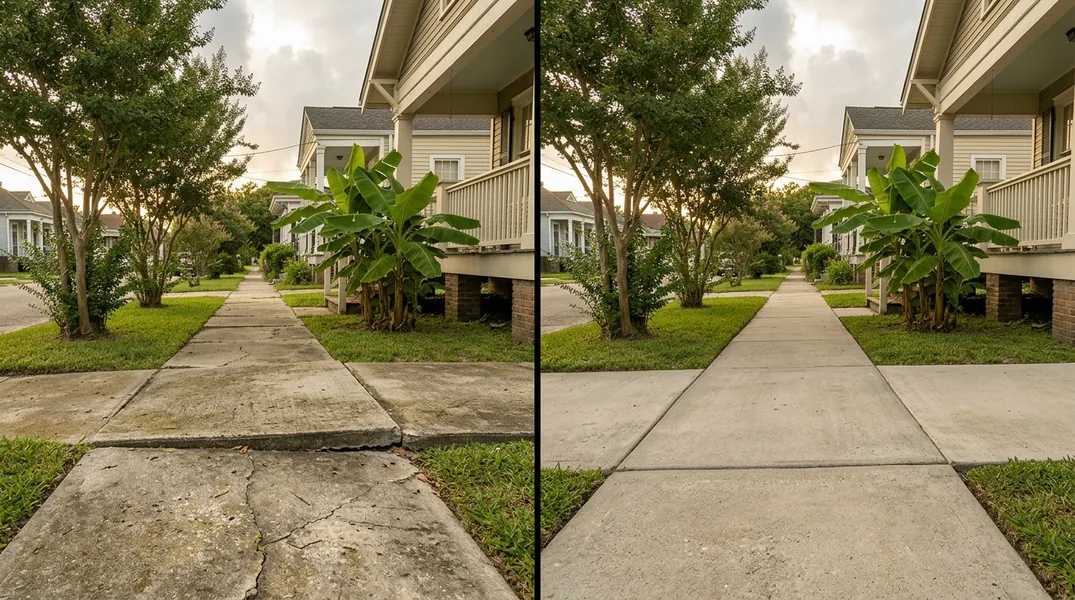
Understanding New Orleans' Unique Soil Challenges
If you own a home in New Orleans, you've likely noticed that concrete doesn't last quite as long here as it does in other parts of the country. This isn't a coincidence, and it's not a reflection of poor workmanship. The real culprit lies beneath your feet: the soft clay and silt that make up the foundation of our region. Unlike areas built on stable bedrock or well-compacted soil, New Orleans sits on layers of soft sediment deposited by the Mississippi River over thousands of years.
The soil composition in this area is fundamentally different from what you'd find in most of the United States. Our clay is highly compressible, meaning it settles and shifts over time, especially when exposed to moisture and weight. This constant movement creates a hostile environment for concrete structures. When your driveway or patio is poured on this unstable foundation, it's essentially sitting on a surface that's slowly sinking and shifting. Over months and years, this subsidence concrete cracking in Louisiana becomes an inevitable problem that homeowners must contend with.
How Subsidence and Settlement Damage Concrete
Subsidence is the gradual sinking of land, and it's a defining characteristic of the New Orleans region. As the soft clay beneath your concrete compresses under the weight of your home, driveway, or other structures, the ground surface slowly drops. This isn't a dramatic collapse that happens overnight. Instead, it's a slow, relentless process that can occur over several years. The problem becomes acute when different parts of your concrete settle at different rates. When one section of your driveway sinks faster than an adjacent section, the concrete experiences stress and begins to crack.
The moisture content in our soil makes this problem even worse. New Orleans' high water table and frequent rainfall mean the clay is almost always saturated. Wet clay is weaker than dry clay and compresses more easily. Additionally, as water moves through the soil, it can wash away fine particles, creating voids beneath your concrete. These voids eventually collapse, leaving your driveway or patio without proper support. A sinking driveway in New Orleans isn't just an aesthetic problem. It can create safety hazards, damage your vehicle's suspension, and eventually lead to expensive structural damage to your home if the problem spreads.
Why New Orleans Soil Concrete Damage Accelerates Over Time
Several factors specific to the New Orleans environment combine to accelerate concrete damage. First, there's the matter of the water table. In many parts of the country, the water table is dozens of feet below the surface. In New Orleans, it's often just a few feet down, and sometimes higher during heavy rains or hurricane season. This constant moisture exposure means your concrete is perpetually in contact with water-saturated soil. Water doesn't just weaken the clay beneath your concrete; it also penetrates the concrete itself, causing internal damage through freeze-thaw cycles and mineral deposits.
The heat and humidity of our subtropical climate add another layer of complexity. Summer temperatures regularly exceed 90 degrees Fahrenheit, and the combination of heat and moisture creates ideal conditions for concrete deterioration. Thermal expansion and contraction, year after year, causes micro-cracking in the concrete surface. Once these cracks form, water infiltrates them, accelerates the damage, and the problem spirals. Additionally, our acidic soil and slightly acidic rainwater gradually break down the cement matrix that holds concrete together. Unlike regions with neutral or alkaline soils, the chemistry of New Orleans' earth actively works against concrete longevity.
Common Signs Your Concrete Is Suffering from Subsidence
The warning signs of subsidence concrete cracking in Louisiana are usually visible before the damage becomes severe. One of the most common indicators is a driveway that's no longer level. If you notice that water pools in certain areas after rain, or if your driveway has developed a noticeable slope, subsidence is likely at work. Another telltale sign is cracking that follows a pattern. Random, scattered cracks can indicate various problems, but cracks that form in long lines or that follow the edge of your driveway often point to differential settlement caused by uneven subsidence.
You might also notice that cracks have widened over time, or that pieces of your concrete have shifted slightly relative to each other. This is called spalling or step cracking, and it's a clear indication that the ground beneath your concrete has moved. If your driveway meets your garage or home foundation, watch for cracks that appear at those transition points. These areas are particularly vulnerable because they're where two different structures meet, and if one settles faster than the other, the stress concentrates right at the joint. If you're seeing any of these signs, it's time to contact a professional for an assessment and discuss your options for Concrete Repair & Resurfacing.
Solutions for Protecting and Repairing Your Concrete
The good news is that homeowners in New Orleans have several options for dealing with subsidence-related concrete damage. The first step is always a professional evaluation. Not all concrete damage requires full replacement, and not all solutions are equally appropriate for every situation. Minor cracks and surface damage can often be addressed through Concrete Repair & Resurfacing techniques that seal and stabilize the affected area. These repairs can extend the life of your concrete significantly and prevent water from infiltrating and causing further damage.
For more severe subsidence issues, mudjacking or polyurethane injection may be recommended. These techniques involve pumping material beneath the concrete to fill voids and raise sunken sections back to their original level. This approach can be more cost-effective than complete replacement and can restore functionality to your driveway. However, it's important to understand that these solutions address the symptoms, not the underlying soil instability. If your soil continues to subside, the problem may eventually recur. When installing new Concrete Driveways, working with experienced professionals who understand New Orleans' unique challenges is critical. Proper base preparation, adequate drainage, and the right concrete mix design can significantly improve durability and reduce future problems.
Choosing the Right Contractor for New Orleans Concrete Challenges
Because concrete damage in New Orleans is so closely tied to local soil conditions, it's essential to work with a contractor who understands these unique challenges. A company that has experience in other parts of the country may not be equipped to handle the specific problems that our soft clay and high water table create. When you're evaluating contractors, ask about their experience with subsidence issues and how they approach base preparation and drainage for new concrete projects. A good contractor will discuss soil conditions with you, explain why certain preparation steps are necessary, and be transparent about the realistic lifespan you can expect from your concrete investment.
New Orleans Concrete has been serving homeowners throughout the region, and we understand exactly what it takes to build durable concrete structures that can withstand our environment. Whether you need a new Concrete Driveways, Concrete Patios, or Concrete Repair & Resurfacing, we bring local expertise and proven techniques to every project. If you're concerned about your current concrete or planning a new installation, we encourage you to reach out for a free estimate. You can also call us at (504) 565-2441 to discuss your specific situation and learn about our pricing options. Don't let New Orleans' challenging soil conditions catch you off guard. With the right planning and professional guidance, you can have concrete that lasts.
Looking for a professional concrete contractor in New Orleans? New Orleans Concrete responds fast for all your concrete needs.
Get a Free QuoteOur services: Concrete Driveways · Concrete Patios · Stamped & Decorative Concrete